Risk communication is a vital skill for scientists, especially those working at the forefront of environmental and social issues like climate change and public health. But what makes risk communication effective in the first place?
Effective risk communication doesn’t just warn people about danger; it’s about helping people make decisions that protect what matters to them. It explains what’s happening, why it matters, and what they can do to stay safe. It empowers action. The Hazard-Impact-Action framework offers a straightforward way to add more depth to your risk communication and provides context for ultimately why an audience should take a prescribed action.
Hazard-Impact-Action Overview
The hazard is often the inciting event/issue that is the fundamental driver of a risk communication effort. It might be, for instance, lead exposure, wildfire risk, or even something as simple as something on the road that drivers need to be aware of for safety. It’s the problem that an audience needs to be informed of.
Second, the impact is what might (or will!) happen if the hazard isn’t addressed. It’s the harm that might be experienced from not taking an action. It is broadly defined, and naturally dependent on the precise nature of the hazard itself. It can be as wide-ranging as risk to human health and wellbeing, damage to property, or loss of livelihood. It focuses on what connects your audience to the hazard: why should they care? Furthermore, what do they stand to lose if they don’t take action?
When communicating risk, alerting someone to a hazard frequently isn’t enough. Divorced from context, the message can seem arbitrary and abstract. All too often, it begs the question “So What?” from an audience in a defensive way that leads to resistance to the risk messaging.
Finally, the action is what can be done (or at least, what you, dear reader, recommend) to limit or mitigate the hazard, and avoid the impact. Any communication that doesn’t include an action, is unlikely to lead to the desired change. It should be grounded in tangible, actionable, realistic steps that you can reasonably expect your audience to take. If the action is out of reach, then your efforts are for naught.
If you’re familiar with the COMPASS Message Box, you may notice some overlap. Hazard-Impact-Action aligns closely with core elements of that structure: identifying the problem, clarifying why it matters (the So What?), and offering a concrete solution. The Message Box goes a step further and explicitly addresses Benefits: the positive outcomes that will come about by taking action. Focusing on what constructive outcome will emerge from an action is a vital part of any risk communication. Rather than implicitly dissuading an audience from acting upon information by scaring them or making them feel helpless, a positive framing gives them tools to address whatever the challenge is, and take agency in doing so. Read more how positive framing strengthens this risk communication messaging here.
Hazard-Impact-Action in Practice
To step into the first person for a moment, a few months ago I was at the Grand Canyon, which is in my opinion, the single most beautiful, staggering sight I’ve ever seen, and I’m lucky enough to have seen it several times from several angles. It never gets old.
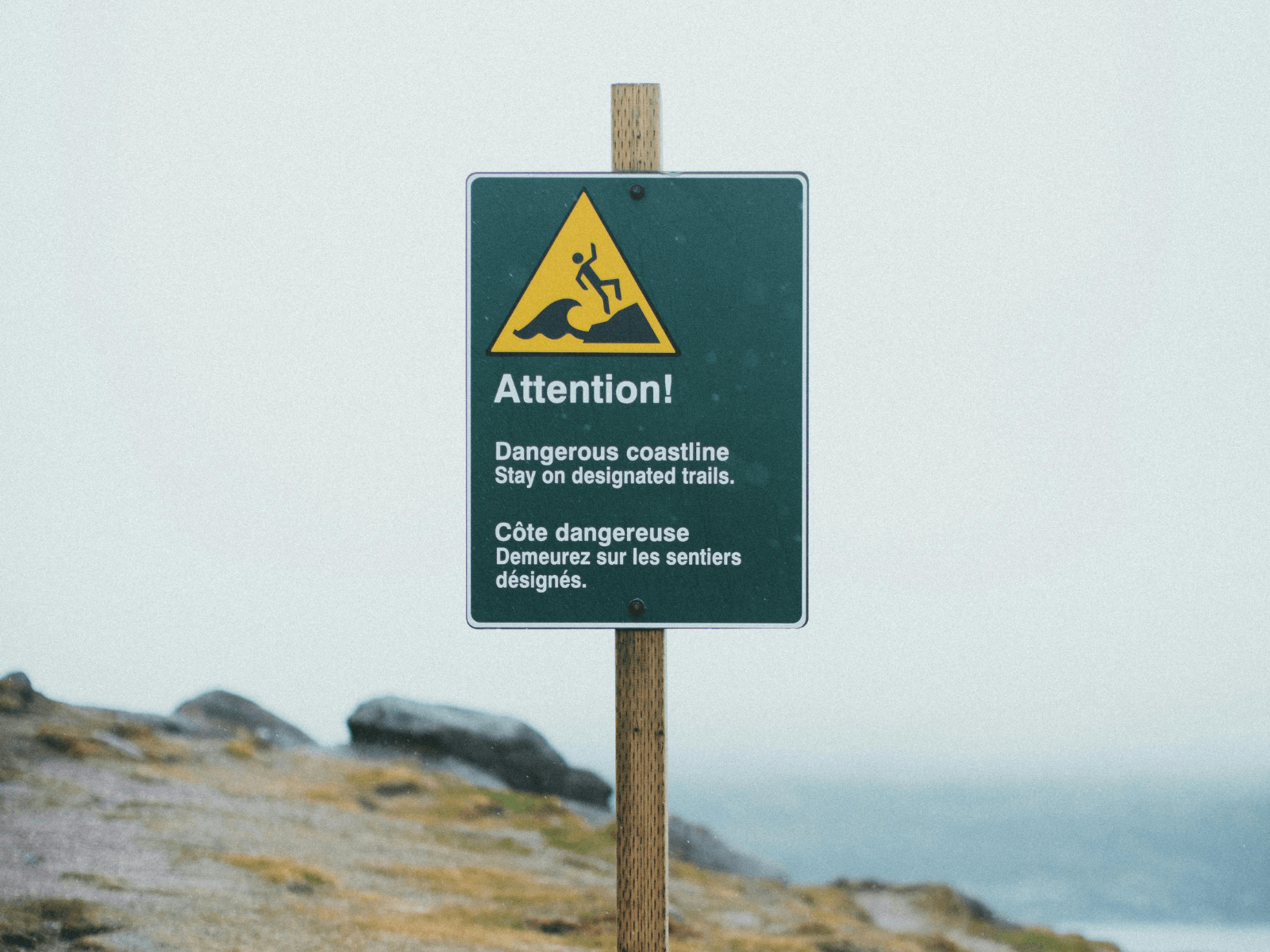
However, it is also a deadly landscape. Between the sheer cliffs, dangerous wildlife, long trails with extreme elevation change, and (most dangerous of all) extreme Arizonan temperatures, it’s an easy place to get in trouble. Thus, the signage has a lot of heavy lifting to do in order to keep the already overworked National Park staff from getting stretched even thinner.
And they do a great job, chiefly by using the Hazard-Impact-Action framework. At one trailhead leading to the Colorado River from the canyon rim, I was pleasantly surprised to see, in very frank language, a sign warning Grand Canyon visitors about heat exposure and its consequences.
Asking rhetorical questions, the sign (approximately) said:
- Do you know how hot the Grand Canyon gets in the summer? (the hazard—extreme temperatures in the Grand Canyon lead to emergency medical evacuations and deaths every single summer)
- Do you know how hot the human brain has to be before it starts to cook? (the impact—when the body temperatures rise to around 104 degrees Fahrenheit, the human brain’s chemistry can fundamentally, life-threateningly, change in ways that warrant immediate medical treatment, which is not always possible in the desert)
- Do you know how to avoid this? By hiking before and after the sun is up and drinking two liters of water per hour of exertion! (the action—the sign gives the reader agency by providing concrete ways to address the heat and exposure challenge: avoiding direct exposure to the hottest part of the day and staying extremely hydrated is the best way to avoid life-threatening heat exhaustion or stroke! It gives the audience a list of tools to concretely address the heat and exposure challenge)
And to touch on the positive framing note, the sign was ultimately oriented around ensuring that visitors to the Grand Canyon are able to enjoy their time there safely so they will be able to return home with memories that will last a lifetime. Every sign at the Grand Canyon emphasizes the majestic beauty of the landscape, and the ability to experience it, whether it’s from the rim or the Colorado River, or somewhere between the two, is the ultimate upside of navigating the landscape safely.
In this example, all three elements of the Hazard-Impact-Action framework were plain to see, and — as both an outdoor recreationalist and communicator — it was heartening to see other visitors seriously reading the signs.
The Hazard-Impact-Action framework is a great way to structure your risk communication strategy—it outlines the barebones pieces of information an audience needs to hear in order to act with context. If you’re interested in learning more about risk communication, keep an eye out on our public workshops to sign up for our next Communicating Risk workshop or get in touch with us about our customized group workshop or personalized coaching! We’d love to work with you.