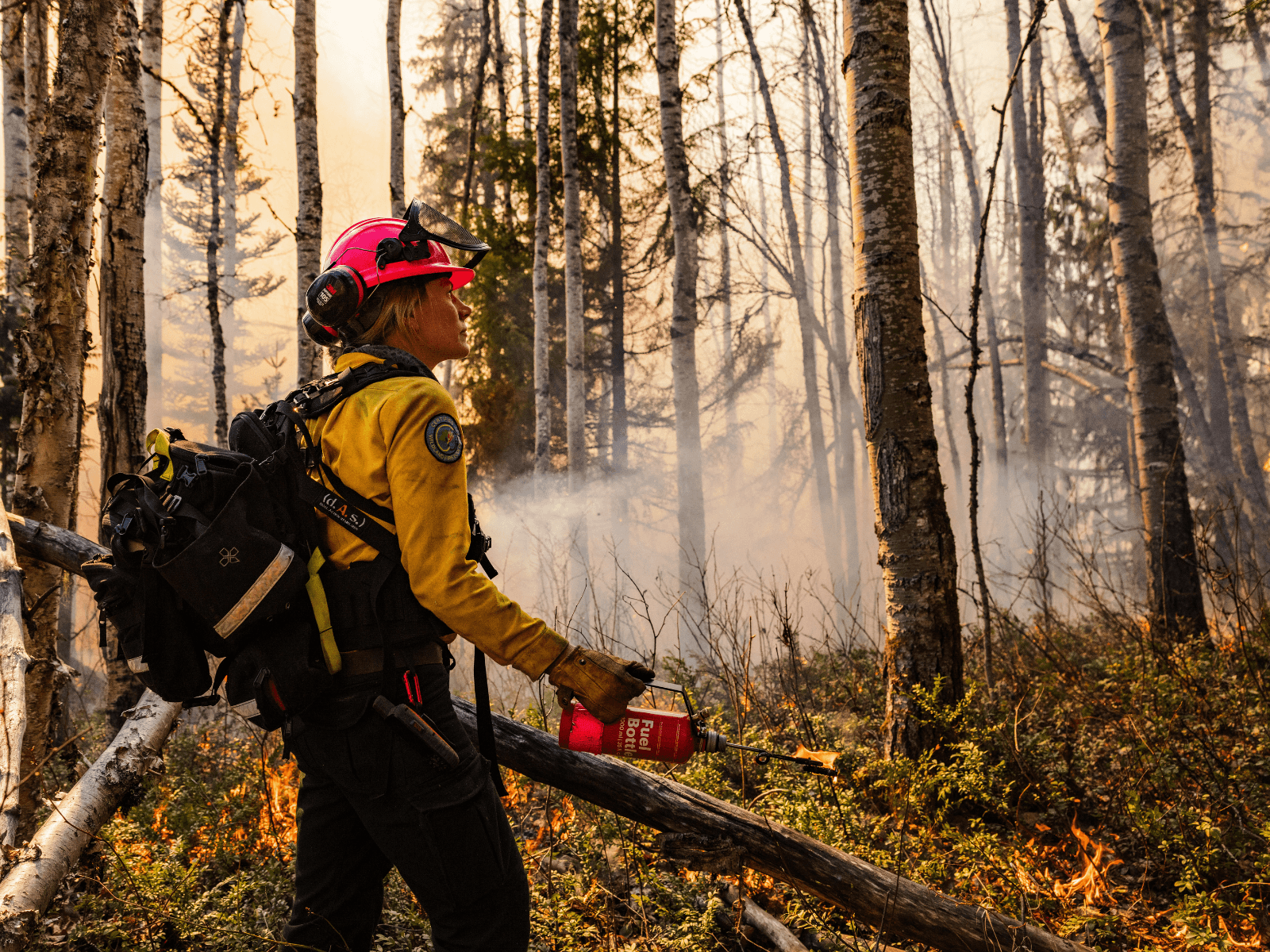
In northern British Columbia a group gathers at the edge of a recent burn. Smoke drifts low across the landscape. The ground is warm underfoot.
For ten days, the Gitanyow Lax’yip Guardians together with the Gitsxan Firekeepers, BC Wildfire and fire practitioners carried out several cultural burns.
“It was so neat to see people step into leadership roles and feel confident returning fire — in the way that they know it needs to be returned — to places that haven’t burned in a hundred years,” says Dr. Kira Hoffman, a fire ecologist at the University of British Columbia.
Now, at the end, something has shifted — both in the land and in the people.
“When we burn almost 100 hectares in a season, you see the landscape change before you. You really see the progression of ideas.”
On the final day, people hug. Some are in tears.
“This is the best time of year,” they say, “when we get to burn together.”
Learning to Burn
The burns are part of a broader fire stewardship program focused on supporting Nations to lead cultural burning, wildfire response, and land management on their own terms.
For generations, fire has been treated primarily as a threat to suppress. But the work Kira partners with Nations on is rooted in a different understanding: that fire was—and still can be—a tool for renewal, stewardship, and connection.
“Wildfire is a catastrophic disaster. It definitely is — there’s no doubt about that in my eyes. But it’s also one of the only disasters with a really good side.
We all evolved with fire. It’s one of our greatest human achievements. Fire brought us culture and safety and language. It transformed us into these complex beings. No one’s not feeling good when they’re gathered around a campfire… people feel a sense of connection and belonging.”
That recognition changes not only how fire is managed, but how people relate to it.
It also brings a sobering perspective to today’s wildfire crisis:
“How did we get here? A hundred years ago, we had a completely different way of managing fire. Many of the things we’ve done have been to our own detriment, but it’s understandable, as fire can be a scary thing and it’s natural to want to control it.”
But putting fire stewardship into practice required Kira to rethink her role as a scientist and leader.
“I wasn’t the fire ecologist I wanted to be”
For years, Kira was doing what many scientists are trained to do: collect data, analyze it, and translate it for others.
But that process wasn’t working the way she expected.
“I’ve been collecting data for quite a few years on fire, and it just became clear that it wasn’t the right data for the community… they weren’t going to utilize it the way I was.’
The realization was uncomfortable, yet clarifying.
“I’d just been trying to translate these really complex things and missing so much along the way. I realized that I wasn’t the fire ecologist I wanted to be.”
Kira reshaped her approach around a valuable question: What do communities actually need from research and who gets to shape it?
“I thought I was doing co-production work before, but not really. It wasn’t meaningful, and it hadn’t been tested. I failed and then adapted.”
The change came from listening to the community.
“I realized after many hours of talking to people and being in the field with them that it’s not really about the amount of tonnage of fuels on the land. Communities want to know more about the health of plants and animals and biomass — and you can get there by listening to the crunch of fuels, watching pollinators flying around, or just touching the soil: What’s the temperature? Is it warm and wet?”
Instead of leading with external research priorities, Kira and her collaborators shifted toward work that is truly Indigenous-led: designed, carried out, and interpreted by the communities themselves.
Measurements like fuel loads gave way to observations rooted in lived experience. And with that shift came trust.
Adaptable Leadership
This kind of deeply collaborative, complex work requires a different kind of leadership — one grounded in place, flexibility, humility, and shared problem-solving.
Kira credits part of that growth to her experience with COMPASS, where she participated in a leadership program alongside other conservation scientists who were learning how to communicate and lead change more effectively.
“It was a pretty life-changing event for many people. I realized that I need to be a different leader at different times, because people need different things at different times. It really made me question who I am as a leader, who I want to be, and the real importance of community and problem solving together. ”
That flexibility shows up in how research is designed, how partnerships are built, and how knowledge is shared.
It’s what allows science to move beyond collection and publication into meaningful practice.
Scalable change
Kira’s work has gained international recognition, including being named a National Geographic Visionary Changemaker.
Her response was characteristically grounded:
“I was kind of laughing because I thought, ‘Well, this is probably the peak of my career.’ And then the same day the announcement was made, I was also dealing with ice jamming and flooding in my driveway. Nothing’s really changed in my world.”
Still, she hopes the recognition brings attention to the work itself.
“I hope it opens doors. I hope people continue to fund this type of research because it’s so important. We’ve really weighed heavily towards valuing a certain type of knowledge and missed so much about our ability to understand our world and our connection to each other.”
“I also just feel so humbled and grateful to be selected next to not only Han Solo, but Obi-Wan as well,” she adds.
Looking ahead, Kira is focused on expanding land-based learning where people come together through fire in creative, community-centered ways.
At one recent gathering, participants collected ash from a burn and turned it into paint for drums and canvases.
“It was just so beautiful. Fire has this really cool ability to be art and science and community. I don’t think I will ever get tired of learning about it.
I know these are small events, but I feel like the scalability of them is kind of incredible. Taking this multifaceted look at something is so valuable.”
Support more scientists like Kira
Kira’s work shows what becomes possible when scientists are equipped not only to conduct research, but to build trust, communicate across perspectives, and work alongside communities to create lasting change.
As uncontrolled wildfires become more frequent and severe, we need more scientists who can bridge knowledge systems, support community-led solutions, and help turn expertise into action.
If you’re able, please consider making a gift today. Your support helps more scientists like Kira communicate, collaborate, and lead where it matters most.