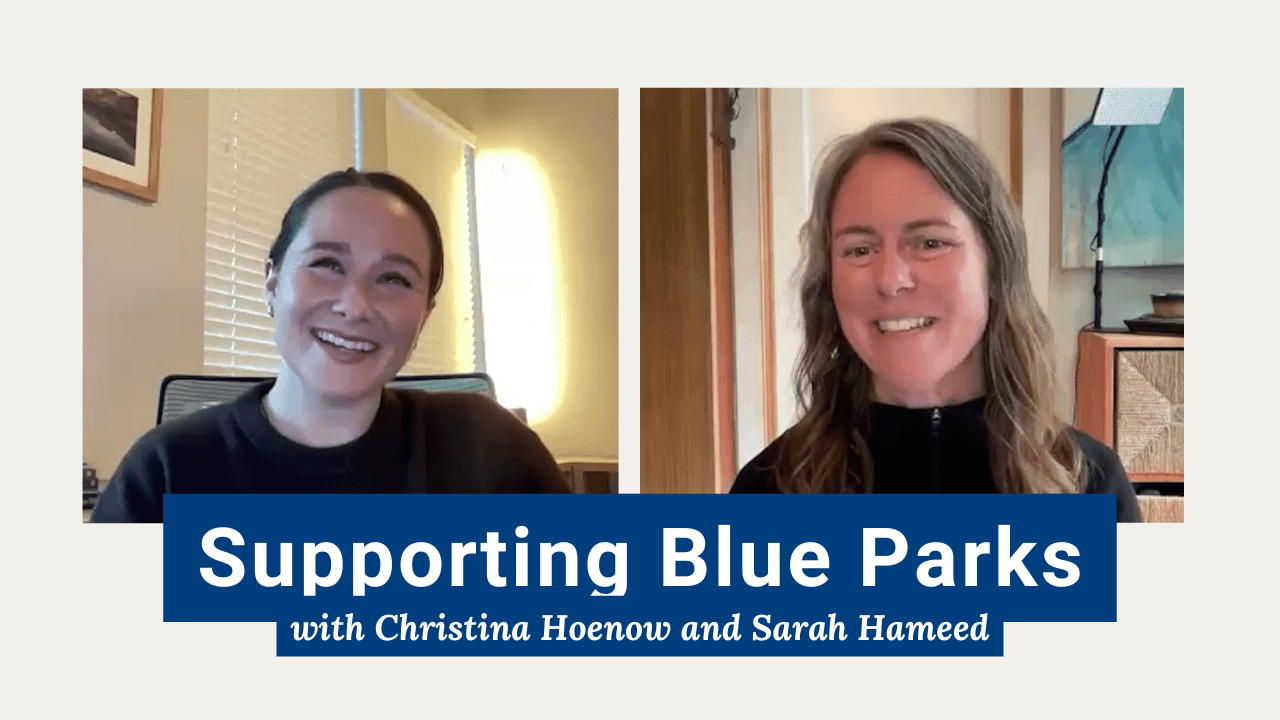
In this conversation, COMPASS’s Christina Hoenow sat down with Sarah Hameed, Director of the Blue Parks Program and Senior Scientist at the Marine Conservation Institute, to talk about the Supporting Blue Parks program, a collaborative initiative designed to help marine protected area (MPA) managers strengthen their communication skills and capacity to build public support for conservation.
Together, they reflect on what we learned through the program, why strong communication and community engagement are so important for marine conservation, and how storytelling and strategic engagement can foster connections between people and the places we work to protect. They also explore some of the exciting communication and storytelling efforts happening across the Blue Parks Network, including at IMCC8 in Edinburgh.
We’re excited to share some of the stories, insights, and lessons that came out of this partnership. We’re grateful to Sarah and the Marine Conservation Institute for their partnership and the Paul Angell Family Foundation for their generous support of this program!
Learn more and explore the programs and parks mentioned in our conversation:
- Blue Parks Initiative
- The Blue Parks Standard
- Blue Sparks collaborations
- Marine Protection Atlas
- Ocean Revolution Mozambique
- Tubbataha Reefs Natural Park
- Chumbe Island Coral Park
(View the full IMCC8 program here)
Friday, November 13, 2026
- 8:00AM – 12:00PM
Workshop: Marine Conservation Institute’s Applying the Blue Park Standard and The MPA Guide to the High Seas
Saturday, November 14, 2026
- 11:00 – 12:45 PM
Open Symposium, “Ocean Science and Conservation Communication: What’s New and What’s Next?”
Christina will share lessons learned from the 2026 Supporting Blue Parks program.
- 7:00 – 9:45 PM
IMCC8 Film Night
View Ocean Revolution Mozambique and Marine Conservation Institute’s collaborative short film The Blue Spark of Inhambane Bay
Sunday, November 15, 2026
- 12:45 – 2:15 PM
Workshop: COMPASS’s Storytelling for Conservation: An Introduction to Building Impactful Conservation Stories
- 2:15 – 3:45 PM
Ocean Science and Conservation Communication: What’s New and What’s Next?
Sarah will share lessons on transforming MPA science into action through standards and initiatives.
Christina: Hi, everyone. I’m Christina Hoenow. I am a program manager at COMPASS Science Communication, a nonprofit that helps bridge the gap between scientific knowledge and public understanding. We support scientists, researchers, conservationists, and experts of all kinds to communicate effectively, connect with diverse audiences, and bring their expertise into decisions that shape our futures.
I’m joined today by the wonderful Sarah Hameed, Director of the Blue Parks Program and Senior Scientist at the Marine Conservation Institute, where she works to accelerate effective
ocean conservation to protect marine biodiversity worldwide.
Sarah, I’m so excited to have this conversation with you today and to share more about the work we’ve been doing to support the Blue Parks program. Thank you so much for joining me.
Sarah: Me too. It’s been exciting to be working with you in this capacity this year.
Christina: Wonderful. So, to kick us off, could you tell us a little bit about your journey into the marine conservation space? What drew you to marine conservation in particular, and ultimately, to develop the Blue Parks program?
Sarah: Absolutely. Well, like I think many, I did not have a super linear trajectory straight into becoming a marine conservation scientist. But I did grow up on Maui, where as a child, I was exploring coral reefs and coastal ecosystems. And I think that played a really important role in how I see myself and my role within my communities — and kind of within the world around me as well.
So, you know, fast forward and I’m a high school history teacher, in my early career. I start volunteering at a local marine lab, and I love it. And it speaks to this sort of deep passion I have around marine ecosystems. So I switch gears entirely, and I go back to grad school. I ultimately earn a PhD in ecology at UC Davis, knowing that I really want to get engaged in conservation.
So I’ve now worked for about 15 years or more focused on marine conservation from a science perspective. And the storyline sort of throughout that time span has been: Wow! Marine protected areas — and we’ll, I’m sure, end up shortening them in this conversation to MPAs — MPAs are really powerful and simple tools for conserving biodiversity. We stop doing, you know, activities in a marine area that are damaging and harmful and whoa, boy, is the ocean amazing at rebounding! You know, fish populations coming back, ecosystems thriving, all of the things. That’s, I mean, that’s kind of magic.
And wow, are we really good at not implementing marine protected areas very well. Because most of them don’t work like that. And yet, we’ve done a lot of science to figure out what makes the good ones work and what makes the bad ones not work so well. So geez, can’t we get this right?
So that’s what I have focused a lot of my career on. This idea that a lot of marine protected areas exist on paper, but aren’t producing the conservation outcomes that they were put in place to produce.
So, fast forward to now, and I’m working in Blue Parks, the Blue Parks Initiative, which you’re very familiar with, and which is intended to try to address that gap. So we’re setting a science based standard for marine protected areas with the Blue Parks Standard, and that is meant to guide efforts and show governments and managers and their partners what it takes to implement a really strong marine protected area.
We incentivize the standard with the big, prestigious Blue Park Awards that are handed out annually to those folks who are behind the marine protected areas that have all the right ingredients to work and meet the Blue Park Standard.
And we now support local leaders who are trying to achieve the standard with new marine protections and kind of leading efforts to add protections around the global ocean. So those are our Blue Spark collaborations, and we work to support those and help kind of accelerate their progress.
Christina: Yeah. Wonderful. I love that you brought up the idea of the magic of marine protected areas, because I have my own story of the first time I dove in the marine protected area, and how that inspired me to go back to graduate school and end up in the space that I’m at now, meeting you and working with the Marine Conservation Institute.
And that magic is really, I think, the key. And it’s at the heart of this program, the Supporting Blue Parks program. How do we communicate that outside of the people who get to experience it every day? How do we share that magic that Blue Parks and marine protected areas have?
So I want to take a little bit of a step back, and I would love to hear: what are some of the biggest challenges that MPAs are facing currently? And what needs are you seeing amongst MPA practitioners on the ground?
Sarah: Yeah. Well, so MPA implementers: those managers and their partners and governments
and community leaders—I kind of include all of those in the MPA implementers category.
But there are a lot of challenges. And I think chief among them, kind of widely recognized at this point, is capacity. Marine protection is under-capacitated, much like, you know, a lot of conservation efforts, terrestrial too. But in particular, marine protection is underfunded. Globally. And this relates to a lot of other challenges that they face because they’re underfunded to, you know, implement effective, you know, management strategies. They’re underfunded to create effective compliance strategies to ensure high compliance. So, you know, this kind of trickles out into all sorts of aspects of, you know, effective implementation for marine protection.
But a lot of it comes down to underfunding.
Christina: Yeah.
Sarah: And the places that kind of overcome this challenge the best —and certainly, you know, there are differentials; there are governments and communities that are, you know, funding their marine protection better than others—but even then, the places that do the best are the ones that have a really strong community supporting them through the tough times, right? And adding capacity even where there isn’t a budget. And so developing partnerships and support networks and sort of direct community engagement in management and compliance and all of those aspects of important, you know, that are important to MPAs.
And as I know you and I have talked about a lot, this is where communications and communication skill sets are so valuable to marine protected areas, because rallying communities for marine conservation, communicating to governments the need for budget and capacity and staffing, reaching out to potential partners—all of these involve communication skills.
And the managers, again, who are, you know, we find the management teams that are most successful, are the ones that hook all of those kind of different groups and stakeholders and build a strong network around themselves. And they’re doing that typically without a lot of training or skill, because communications is often not the piece that’s funded either. So the more that kind of skill set is built, the more effective they become—those implementers become— at building this network of support.
Christina: Yeah, yeah. Building those relationships that help fill the gaps that we see so often and across scales for marine protected areas, down from the smallest, like Siete Pecados in Palawan in the Philippines, up to our massive marine protected areas here in the U.S., like Papahānaumokuākea.
Understanding [how to foster] that public engagement and that public understanding of the
importance of these spaces and how those relationships can really become valuable. One, in the sense of creating buy-in and, you know, rule-following on the ground around the marine protected area. But then also when it comes to, you know, the threat of rollbacks of marine protected areas around the world. You need those champions for marine protected areas. And that’s where that engagement and communication skill set is so critical.
So that brings us to my next question about the specific program that we developed, the Supporting Blue Parks program. I would love to hear from your perspective a little bit about why this program in particular was so exciting for you.
Before we jump into that, I’ll give a… After we jump into that, I will give a little rundown of the specifics of the program and what exactly we did.
So yeah, I’d love to hear from you. What exactly about this program was so exciting for you as the Director of the Blue Parks Network?
Sarah: Absolutely. Well, first, I’ll just mention a big debt of gratitude to the Paul Angell Family Foundation for supporting this program. They’ve been such strong supporters of Blue Parks, and we couldn’t have done it without them. So, thanks to them.
And I will say this was exciting because this brought, you know, this communications capacity that we’re talking about that’s so valuable to really everything that managers do in terms of building their support network. Brought it to the whole network. So this was an offering of, you know, skill building and capacity development brought to all the Blue Parks who wanted to participate and all of our Blue Spark collaborators—really valuable for them as they’re trying to move towards achieving the Blue Park Standard and, you know, building new strong MPAs or upgrading existing MPAs. So that was really exciting.
And I know that that goal of bringing it to everyone, created an extra challenge. We’ve got Blue Parks and Blue Sparks literally all over the globe.
Christina: Yeah.
Sarah: They are in, you know, representing many different countries and Indigenous territories, and they are completely spread out. So finding a time zone that worked for everyone was totally impossible. And we did the best that we could, overcoming, you know, all the logistics like language challenges and all of those pieces. So, it was exciting and also a challenge to create this project.
But it also—and I know you’re going to get into the details— but it allowed each Blue Park or Blue Spark team or individual to zero in on a specific communications challenge and audience that was going to help them advance their conservation goals. So whether that was communicating better with their communities, communicating better with certain users of the marine park, communicating better with their governments, you know, whatever that was, they could really get into a specific communications challenge that they’re facing and develop their program around that.
Through this series of workshops that happened over about eight months they were getting tools and perspectives from the COMPASS team. But then they also had time to put those tools into play and into practice in their own missions and projects and do some one-on-one coaching with you and COMPASS team members. So that was really exciting.
Yeah. And I’ll let you kind of dig into what you want to dig into — the specifics of how that played out. I think that was what I was excited about.
Christina: Yeah. Wonderful. Yeah, really getting to that opportunity to help each Blue Park that fully participated in the program really, I think, recognized their areas of need and their specific challenges.
And I think that was one of the greatest things that came out of the program, is that we created a space where the Blue Parks could come together in a kind of curated and guided, productive space so that they could learn from each other, talk about their shared challenges, talk about methods to overcome some of these challenges and really create that network that the Blue Parks Network is designed to be, you know — the sharing of resources, the sharing of
knowledge, the sharing of capacity, I think, is one of the really, really cool things that was most exciting for me.
In terms of what the program actually looked like, for folks listening who, you know, were unaware of this program. What we ended up doing is we had a series of three workshops that we designed based on survey data that we got from the Blue Parks Network in regards to what are the specific skill sets that they really wanted to develop.
So, we dove into an introduction to strategic communication. So, you know: How do you design effective messages? How do you identify key audiences? How do you tailor your messaging and your communication and engagement efforts for a specific goal, ultimately, so that way it’s not just like you’re throwing information out there? You’re being really strategic and really being careful with the amount of time and effort that you put into your communications work.
Then we dove into storytelling for conservation, which is one of my favorite parts. Stories are so important. It gets to that magic of MPAs that we talked about, and we have some really great stories that have come out of this program.
And then our last workshop that we did was around understanding how to strategically engage. So how do you plan a… how do you develop a strategic engagement plan? And really getting into the nitty gritty of, you know, ‘How do I develop material for online and in person?’ and ‘How do I pull those threads through all of this work so that I’m not being duplicative in my efforts, so that I’m making the most of the limited capacity that I have, and so that I’m being as impactful as possible with my messaging, ultimately?’
Then the program got into a couple months of small group coaching where we worked individually and in small groups with the Blue Parks.
And then we wrapped up with a final call where the Blue Parks got to do a bit of a show-and-tell where they talked about the lessons that they’ve learned, the things that they’ve been able
to put into practice, and the things that they’re excited to keep working on in this space. And that resulted in some really, really exciting outcomes.
I want to share one little piece of feedback that we got in our final survey. This is from one of the participants. And they said, “This program changed how I view conservation from simply protecting marine resources to building stronger relationships with the people who depend on them. I learned that effective conservation requires clear storytelling, meaningful community participation, and messages that connect environmental protection with people’s daily lives.”
And I think that really highlights the heart of what we were getting at with this program. It is taking the kind of wall that gets built up between the idea of conservation and, you know, this idea that in order to preserve places and create effective MPAs, you’re removing all of the use and you’re removing all of the burden on it, when in reality you are creating that connection
between people and the places that they live in and the places that we really need to protect.
So that’s just…it was a wonderful, wonderful program. And I’m so excited that we got to partner with you. And again, thank you to the Paul Angell Family Foundation for supporting this work as well.
So that’s kind of the nitty gritty of this work.
I’d love to look a bit broader now, and I’d love to hear from you, Sarah. We’ve been so inspired by all of the communication and engagement efforts happening across the different Blue Parks via this program, as well as in other capacities and channels as well. And it has really highlighted for us the impact that communication can have in shaping how people experience and relate to a protected area.
I’m wondering if you could share an example of, you know, some sort of really exciting or cool or impactful communication effort from a Blue Park that you’ve seen recently, why it has stood out to you, and what’s most exciting about it?
Sarah: Yeah. Well, you know, we’ve been talking about how valuable communications is for individual marine protected areas and their effectiveness, but it’s also a really important and valuable tool for us in the Blue Parks Initiative, right? We’re trying to elevate these examples— outstanding examples—of marine conservation as models for others to follow, right?
And we do have all different kinds. We’ve got community and Indigenous-led marine protected areas and kind of, you know, national and subnational, government-led marine protected areas. We’ve got huge remote ones and tiny coastal ones and everything in between. How do we tell their stories and get people excited about the magic of real good conservation?
One of the ways we’ve been able to do that recently, and thinking about that recently, is exploring the power of film. Film is just this incredible media for sharing stories and helping people connect with stories. So we’ve been working a lot with a group called The Blue Quest on some films recently that highlights some of our Blue Parks and Blue Sparks. And one of those that I’ll mention is a short film focused on a Blue Spark collaboration with Ocean Revolution Mozambique, in this area of Mozambique, in southern Mozambique called Inhambane Bay.
And this is an area where pretty remote communities, have gotten together with the facilitation
from Ocean Revolution Mozambique to both strengthen their own communities through education and also, connected to that, conserve these really important ecosystems that they rely on in the bay — the seagrass meadows and mangroves.
So it was so cool to bring their story to film, to be able to share that story in ways that only they can tell it, right? It doesn’t carry the same weight if I, you know, when I tell the story of what they’re doing. I am wowed by it! But you don’t get the full sense of it until you see the folks involved talking about it and talking about what they’re doing there.
So that’s one, and that really, you know, brought home to me the power of film for allowing folks to share their stories in their own words and allowing people, you know, far, far away from them, who maybe don’t have a chance to go visit them in Mozambique, to learn from those stories.
So I’m really excited about that and excited to share that short film.
Christina: Yeah. Yeah. Awesome. Your point about the value being in people telling their own stories and in people sharing their personal connections, I think this highlights one of the big challenges that we worked on through the Supporting Blue Parks program, and that we’re seeing across the conservation space as we really get into talking about, you know, how do we make this generational, long-term impact and change?
You know, how do we know that we’re creating protected areas and protecting these spaces forever, in perpetuity, and not just for, you know, now, in the next ten years?
And that was one of the most exciting things coming out of the Supporting Blue Parks program: so many of the Blue Parks are looking toward the future. Okay, we have the park established. We have, you know, the really effective mechanisms for management down. How do we now shift the connection and the relationship to essentially children and to the future and to the people who are going to be here for years and years down the line?
And the thread of film as well. There’s really exciting things happening in Tubbataha around, you know, their public briefing materials that they use, where they’re shifting the story from just Mama Ranger, who, you know, helped build the park, to the younger generations who are asking visitors to, you know, take Tubbataha with them into the future and to live the values of Tubbataha and the standards that it sets in how they interact with the ocean around the world.
So really creating that desire to, you know, carry this work on into the future and share it with generations, and not just, you know, have somebody else go and tell your story.
It’s so exciting, and I’m so excited to see the film as well.
So I want to look ahead a little bit as we start to kind of head toward the end of this conversation. I would love to hear from you what you see looking ahead. How can we build on what the Supporting Blue Parks program has achieved and help more Blue Parks teams strengthen their communication and engagement efforts into the future?
Sarah: Yeah, well, so we have our work cut out for us because we already know from the surveys and the signups from this workshop that way more folks wanted to participate than could ultimately participate.
And it’s just the challenges of, you know, folks being incredibly busy, and then the language barriers, and then the time frame barriers, and, you know, trying to coordinate across all of these things with this network.
I know that you and I have talked a little bit about this, but we do want to keep thinking about, okay, we know more people want to participate. How do we get it to them? How do we make this accessible to everyone? And I think we’ve got some ideas, and I know we’re going to keep brainstorming ideas about how to make these pieces and these tools and the workshop itself accessible.
And then we know from responses that the folks who were able to participate found it incredibly valuable and want to keep going, right? Like, they want to keep… they really valued not only all of the tools and all of the support. They really valued the one-on-one consultations and being able to kind of really hone in on their own projects.
But they also really valued the building of this peer-to-peer community with other Blue Parks and Blue Sparks represented. And realizing that they’ve got, you know, they’re dealing with very similar challenges and have a lot to share with one another, and have a lot to, you know, not only maybe receive, but also to give to other groups.
And I know you saw that, and you can probably speak to that more than I can. But there’s a lot to do there.
I know that we are thinking also about every year we’ve got new Blue Parks and Blue Sparks joining the network. And so giving them an opportunity to boost and build their communication.
So we’ve got a lot of ideas going, and I’m really excited to, you know, pursue them and keep thinking about how we make this accessible to everyone.
Christina: Yeah, yeah. Really looking forward to the next evolution of this. And like you said, I think the key takeaway that we’re looking to foster as we move forward is creating those spaces for that peer-to-peer support. You know, really leveraging the incredible resource that getting a Blue Park Award is and the incredible mark of achievement that is, and helping these incredible MPAs recognize that they have immense knowledge and immense value that they can leverage for their own benefit, as well as for the benefit of protected areas around the world.
So keep an eye out for more work from us on this front as we move forward. We’re really looking forward to it.
And, yeah. To close this out, I know we will both be attending the upcoming IMCC8 conference in Edinburgh [this] month, and we’re very, very excited about it. Are you and the Marine Conservation Institute doing anything there that you would like to highlight specifically?
Sarah: Yes. We are actually. Marine Conservation Institute is taking a really big team this year. We got lucky, and we just have a lot to engage with and coordinate there.
So we’re going to be talking about, and workshopping, and listening related to Blue Parks, but also our Marine Protection Atlas and tracking global coverage and quality of marine protection, and our high seas work. And even a workshop thinking about how we apply the Blue Park Standard and the MPA Guide to new high seas MPAs underneath the BBNJ Treaty—I hate to use the acronym: Biodiversity Beyond National Jurisdiction Treaty, which is even a shortened version of the name.
Christina: [laughs] shortened version.
Sarah: What have you.
So we’ve got a lot going on, so I’m not going to list everything. But in terms of Blue Parks, a couple of highlights will be, first of all, that film that I mentioned that we did with The Blue Quest is going to be part of the film night, which is not only open to participants of the International Marine Conservation Congress but also open to the public there in Edinburgh.
So I’m really excited about film night, and either Lance or I will speak on the panel. I don’t think we’ve sorted out who’s going to speak on the panel yet, but afterwards, to talk about that project and that film.
Then on Saturday…
Christina: So that’s Saturday night as well.
Sarah: That’s Saturday night. Yeah. There’s a lot going on on Saturday because you’re going to be talking about this project on Saturday.
Christina: Yeah, yeah.
Sarah: And my colleague Leticia is going to be talking about the Blue Park Standard and lessons learned from using it over nearly a decade now. So those are two talks during the day.
I don’t…
Christina: There’s so much.
Sarah: There’s so much. I don’t know all the times of everything.
Christina: Oh, no, we will share in the post.
Sarah: Okay, good.
Christina: Yeah. We’ll share all the details. For all of us.
Sarah: Yeah. Well, one last thing is that I’m going to be talking about Blue Parks as a communications vehicle, the whole initiative, on Sunday. I was actually hoping to get it into your session, but I didn’t get to that session. So anyway, I’m going to be thinking about, and hopefully, getting feedback on how we think about the whole initiative of Blue Parks as a way to communicate the science of what makes for good MPAs and incentivizing that.
Christina: Wonderful.
Sarah: Yeah, a lot of things going on at IMCC, so really excited about it.
Christina: It’s going to be a busy couple of days.
And yeah, like you mentioned, on Saturday, November 14th, I will be talking about this program specifically and highlighting some of the lessons learned in terms of, you know, how do you address those logistical challenges, but also lessons learned in terms of what are really remote, disparate practitioners looking for when it comes to this sort of external support that can be provided from those of us who are, you know, located in the States or located in Europe.
I’m really excited about that talk. And then Sunday, I will be leading a storytelling workshop featuring one of the stories that the Blue Parks developed during this program, which I’m so excited about.
And I’m really, really grateful to the Chumbe Island Coral Park in Tanzania for allowing me to feature their story that they have worked so hard to develop.
So with that, I want to extend my and Sarah’s sincerest gratitude again to the Paul Angell Family Foundation for supporting this work and for, you know, believing in us and taking a chance on this really critical work that I think people are starting to really grow and recognize the value and the critical nature of this really human-focused side of conservation work.
So again, thank you to them. And thank you to Sarah for sharing your perspective and the work that you’re doing to advance marine conservation.
We have really enjoyed being a part of this partnership and working alongside you to help support and strengthen the Blue Parks Initiative, and I am so excited to build on what’s been accomplished so far and to continue this work into the future.
Sarah: Awesome. Me too.
Christina: Awesome. All right. See you in Edinburgh.
Sarah: Yay!