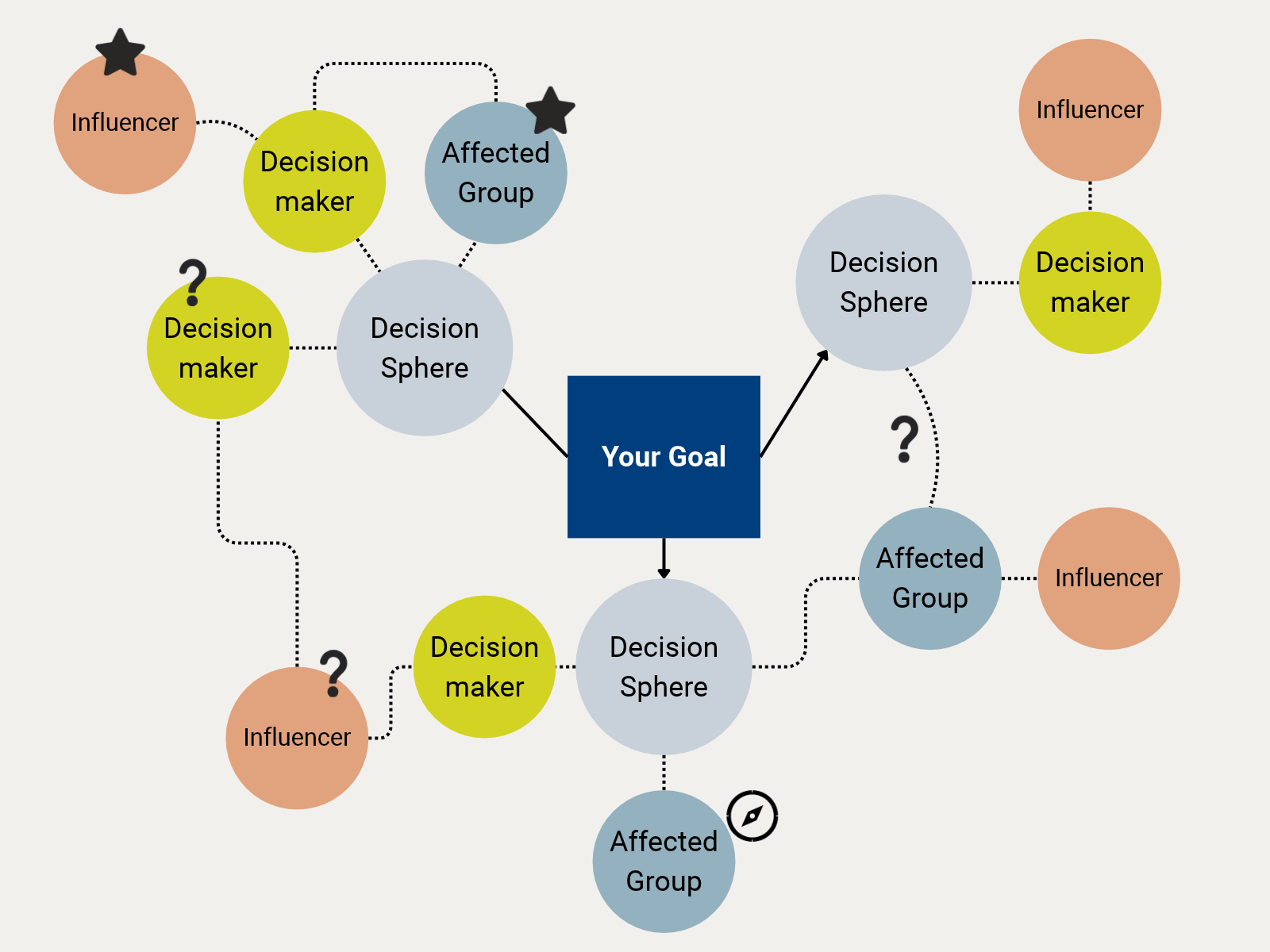
When you are working towards change, it can be hard to know where to start. There’s likely several people, organizations, and decision-making processes all connected to the issue you care about. Who actually makes the decisions? Where should you focus your energy? And where might you already have a connection that you could leverage to help move things forward?
One way to start making sense of it all is to get out a pen and paper (or use your favorite tech tool — we like MURAL) and try an exercise called landscape mapping.
Landscape mapping is a practical, flexible exercise for understanding the decisions and actors connected to your goal: who makes decisions, who influences them, who is affected, and where relationships can open doors.
There are many ways to go about landscape mapping. Here’s how we like to get started.
Step 1: Clarify your goal
Start by clarifying the change you are working toward. Try to make your goal specific enough that you can identify the people, institutions, and processes that shape the path toward it.
For example, your larger goal or purpose may be to protect vulnerable populations during periods of poor air quality from wildfire smoke. That’s a great north star, but it’s also broad. ‘Protect vulnerable populations’ can branch out in several directions. Adding more specific outcomes and context can help you define the boundaries of the landscape you want to explore.
One way to do that is to identify a smaller sub-goal that contributes to your larger vision. For example, you might identify increasing access to clean-air spaces during wildfire smoke events as one key contribution to protecting vulnerable communities. This subgoal gives you a more concrete place to start while still leaving room to explore different pathways for getting there.
As you clarify your goal, ask yourself: What specifically would need to change to see progress?
The more clearly you can answer that question, the easier it becomes to identify the landscape around it.
Step 2: Identify decision spheres
From there, you can start exploring potential decision-making spheres that could shape progress towards your subgoal. Some key areas may include decisions around funding, rules and regulations, operations, and communication. In our example, we might ask:
- Funding: Are there funding programs that could support retrofitting existing community centers to meet clean-air space standards?
- Regulations: Are there decisions about building development that could incorporate air-filtration into new public or multifamily construction?
- Communication: How do residents get information about wildfire smoke and ways to protect their health and access clear air spaces?
You don’t need to know yet if you have the ‘right’ decision spheres or list out every potential decision. Part of the value of landscape mapping is to surface questions. You’ll begin to fill in and revise the landscape as you learn more through research and conversations with the people and organizations involved.
Step 3: Identify key people and groups
Once you have identified some decision spheres, begin mapping the people, groups, institutions, and processes connected to them. It may help to think about three broad questions:
1. Who has formal or informal authority over the decision(s)? (Decision makers)
You may quickly discover that there isn’t one single decision maker. Different parts of the decision may sit with different institutions (even within an institution, different people may have different levels of authority).
You also don’t have to be limited to the formal players in a decision point. If you think expansively about who may be playing a role in a decision point, you may identify key individuals or groups who have informal authority over a process.
That’s one of the benefits of mapping the landscape: it encourages you to think of everyone involved in that decision making point or process, and therefore, see different opportunities to make progress.
In our wildfire smoke example, when and how residents are notified about available clean-air spaces might involve staff at a local public health department, local government, or at the clean-air space sites such as libraries or community-centers.
2. Who will experience the consequences of the issue and/or the decisions being made? (Affected groups)
In our example, children, older adults, people experiencing homelessness or housing insecurity, and people with respiratory conditions are important groups to consider, but they aren’t the only ones. You might also identify people who care for, support, or work closely with these groups, such as caregivers, teachers, and shelter staff.
Someone who is affected by an issue may not be formally included in the relevant decision-making process, but they bring valuable knowledge, relationships, credibility, and lived experience that can greatly contribute to a successful outcome.
3. Who can influence those decision makers or shape the conversation? (Influencers)
Influencers have the power to affect how decision makers and affected groups think about an issue, what they prioritize, or whether they see a particular proposal as viable.
Think about who has influence now, who might have influence in the future, and who may support or oppose the outcome you’re working toward. Don’t be afraid to think outside of the box.
For example, local social media groups, community leaders and organizations, local healthcare providers, and local media could all influence how a community thinks about protecting people from wildfire smoke and the value of making clean-air spaces available.
You may notice overlap between these three groupings. Someone who is affected by an issue may also be an influencer or decision maker. As the map begins to take shape, you start to see the various roles a group or individual can play and, therefore, different ways in which information, ideas, and decisions can move through the landscape.
It’s ok if you don’t know all the parties or how every decision unfolds. As noted above, identifying something you don’t know yet can be very useful and guide what you do next. We recommend adding a question mark or note next to any people, groups, or decisions that you are unsure about. These are questions you can explore as you begin to make connections and have conversations with people and groups you’ve identified.
Step 4: Making Connections
Once you’ve mapped the people and institutions connected to your goal, it’s time to look at the relationships between them and with you.
Ask yourself:
- Who do I already know?
- Who do I want to get to know, and who could help me make those connections?
- Where are there existing relationships I could strengthen?
You may not have direct access to the person who makes a decision. But perhaps someone you already know has a relationship with an influencer who regularly speaks with that person. Maybe a colleague knows a librarian who could help you better understand how libraries respond during wildfire smoke events. Or perhaps you know someone who works at a shelter that already has trusting relationships with people who are experiencing houselessness and rely on public clean-air spaces.
Those connections could become a pathway.
And that brings us to two particularly valuable roles to look for in your network: navigators and champions.
Navigators
Navigators are people who understand the landscape. They can help you identify who you should talk to, make sense of the decision-making process, and better understand relationships and dynamics. Sometimes, they can even help connect you to others.
For example, a school nurse might be able to help you understand how a school decides if they stay open during wildfire smoke events, what guidance the school relies on, and who else you should talk to. A school nurse may even offer to connect you to the school principal, who may agree to host a session with parents.
Navigators don’t have to be completely aligned with everything you’re proposing. What matters is that they’re willing to share their experience.
Champions
Champions, on the other hand, are the people who are willing to actively support your goal.
They may advocate for your idea or lend their credibility to help you build trust and reach people and institutions that would be harder to connect with otherwise.
In our wildfire smoke example, you could find champions in community organizers who share your goal or social workers who are willing to speak with city officials about the value of clean-air spaces for the communities they serve.
The key is that champions don’t just understand the landscape; They’re willing to help you move through it.
From mapping to action plan
Once you have a better sense of the landscape, you can use what you’ve learned to develop a more focused outreach plan. That might include deciding who to connect with first, what you want to learn or accomplish from each conversation, and what channels and tactics to prioritize.
Need some help mapping and navigating the landscape you’re working in? We’re here to help! Through interactive workshops and personalized coaching, we can help you map your landscape, identify potential pathways and connections, prepare for conversations, and develop messages and outreach strategies that resonate with different audiences.
Whether you’re just getting started or ready to turn your map into action, we’d love to work with you.