The ocean is like a giant sponge, quietly absorbing and storing carbon dioxide from the atmosphere. If we could make that sponge even more absorbent — through coastal restoration projects, innovative technologies, or other interventions — we could capture and store more carbon, helping slow climate change and reduce its impacts. That’s the promise of marine carbon dioxide removal, or mCDR.
As the impacts of climate change intensify, interest and investment in mCDR are growing quickly. Yet, as a new field, mCDR comes with risks and tradeoffs — many of which we still don’t fully understand, including major questions around ecological impacts, governance, and public trust.
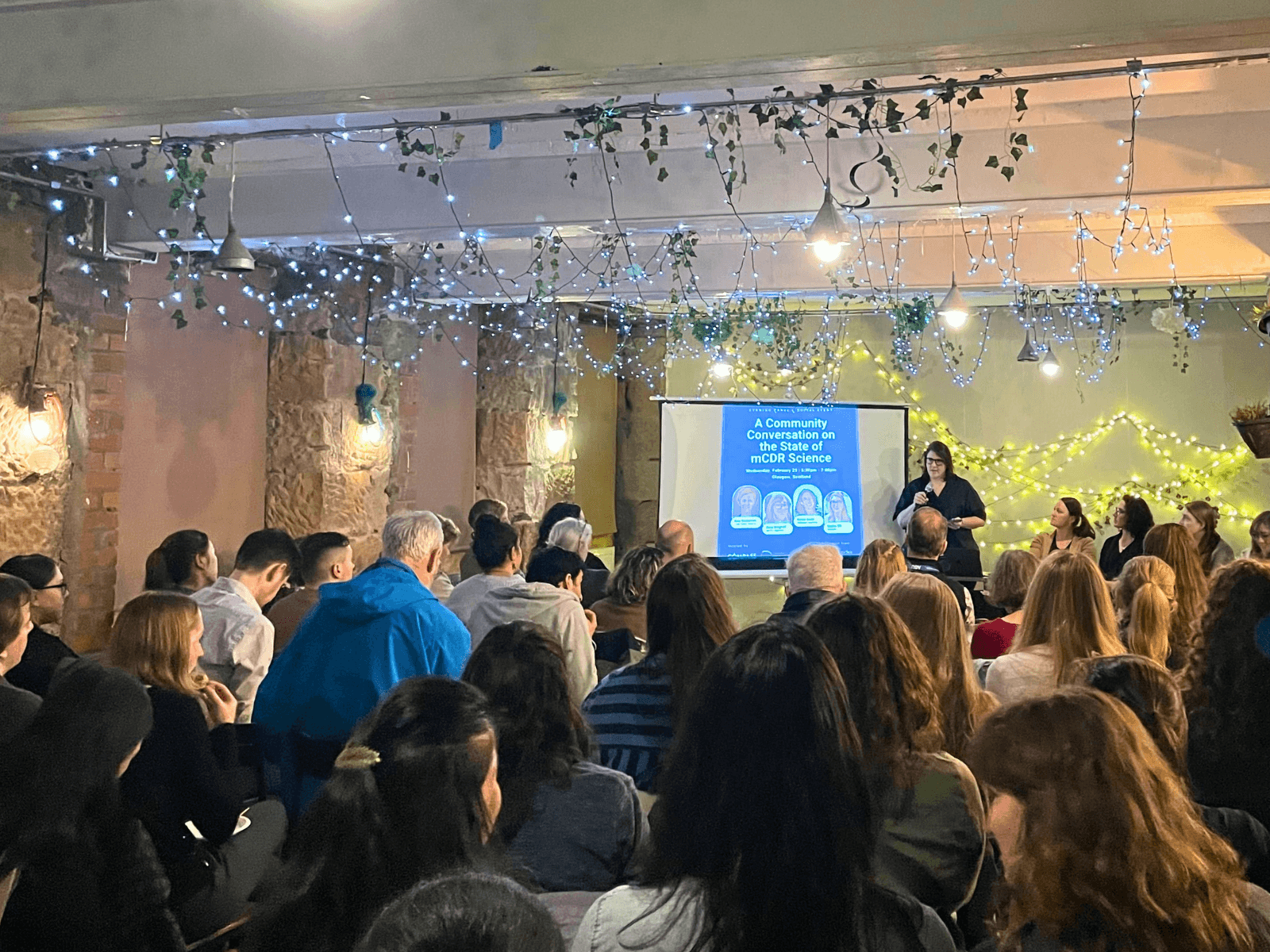
Because mCDR sits at the intersection of ocean science, climate policy, technology, and community engagement, no single discipline or sector can answer these questions alone. Responsible progress depends on open, ongoing, cross-boundary conversations — the kind that was front and center at a recent panel and social event hosted by COMPASS and California Ocean Science Trust in conjunction with 2026 Ocean Sciences Meeting in Glasgow.
The gathering was designed as a “community conversation,” intentionally bringing together participants from across ocean sciences, government, industry, and philanthropy to offer their perspectives, and pose and respond to questions alongside the invited mCDR experts, creating a dynamic discussion about the current state of mCDR science.
Out of this conversation, several key themes emerged:
1. Navigating Uncertainty and Building on Existing Knowledge
The conversation revealed important knowledge gaps and why tackling these unknowns collaboratively is critical.
Specific needs discussed in the event included a stronger understanding of ecological impacts of mCDR at scale and more robust monitoring, reporting, and verification (MRV) systems to support credible carbon accounting and provide long-term environmental insights. As one participant noted, “The biological impacts research needs to catch up to the carbon research.”
At the same time, some highlighted the opportunity to leverage existing ocean science. Existing research and datasets, long-term monitoring infrastructure, and lessons from previous field trials all offer a solid foundation to strengthen future mCDR research and improve applicability.
2. Aligning Science, Industry, and Governance
The conversation also highlighted a familiar challenge in many emerging fields: research, industry, and governance often move at different speeds. In mCDR, private-sector activity is outpacing academic research, while regulatory frameworks are still evolving.
Strong communication across these boundaries is essential to align priorities and support informed decision-making. The event provided space for participants to discuss practical ways to bridge these silos, foster shared understanding, and ensure responsible research and deployment — from public comment and permitting processes to collaborative initiatives.
3. Centering Inclusion and Equity
Questions of inclusion and engagement were central throughout the discussion. Who is shaping the field? Whose perspectives are still missing? What does meaningful community engagement look like — especially for coastal communities, Tribes, and local experts?
One participant asked a grounding question: “Whose voices are not being heard?”
The conversation reinforced that intentional efforts to support inclusive engagement are critical for advancing research, building trust, and ensuring that mCDR approaches are socially responsible.
4. Strengthening the mCDR Community
Participants also highlighted the importance of sustaining the mCDR community itself. Early-career scientists and students are key to sustaining and expanding the field’s collective knowledge over time. Mentorship, knowledge-sharing, and cross-disciplinary connections were identified as key to ensuring the mCDR field grows in a collaborative, inclusive, and enduring way.
5. Supporting Ongoing Dialogue
Perhaps the clearest takeaway from the event was that creating space for open, cross-disciplinary conversation is essential for responsible science. Scientific progress depends not only on data and innovation, but on trust, transparency, and collaboration within and beyond science.
The mCDR community still has significant unknowns, but the conversation in Glasgow showed there is strong willingness to tackle them collaboratively — and to build a field grounded in scientific integrity, inclusion, and responsiveness to societal concerns.
Sustained spaces for dialogue across science, policy, industry, and communities are critical, not just for mCDR, but for any field trying to responsibly navigate urgency, uncertainty, and public trust.
Our deepest gratitude to Carbon to Sea for making this conversation possible and to the panelists who shared their expertise and perspectives: Dr. Carla Berghoff (National Fisheries Research and Development Institute / Instituto Nacional de Investigacion y Desarrollo Pesquero), Dr. Sophie Gill (Isometric), Dr. Kalina Grabb (Dalhousie University), and Dr. Nina Bedarsek (Jozef Stefan Institute). We’re also grateful to Jenni Brandon from Wild Beacon consulting for her thought partnership and contributions. This conversation would not have been possible without their generous contributions.
If you’d like to support efforts to foster collaboration in emerging science fields, please consider making a gift today. Your support helps facilitate essential cross-boundary collaborations that advance responsible, lasting innovation.