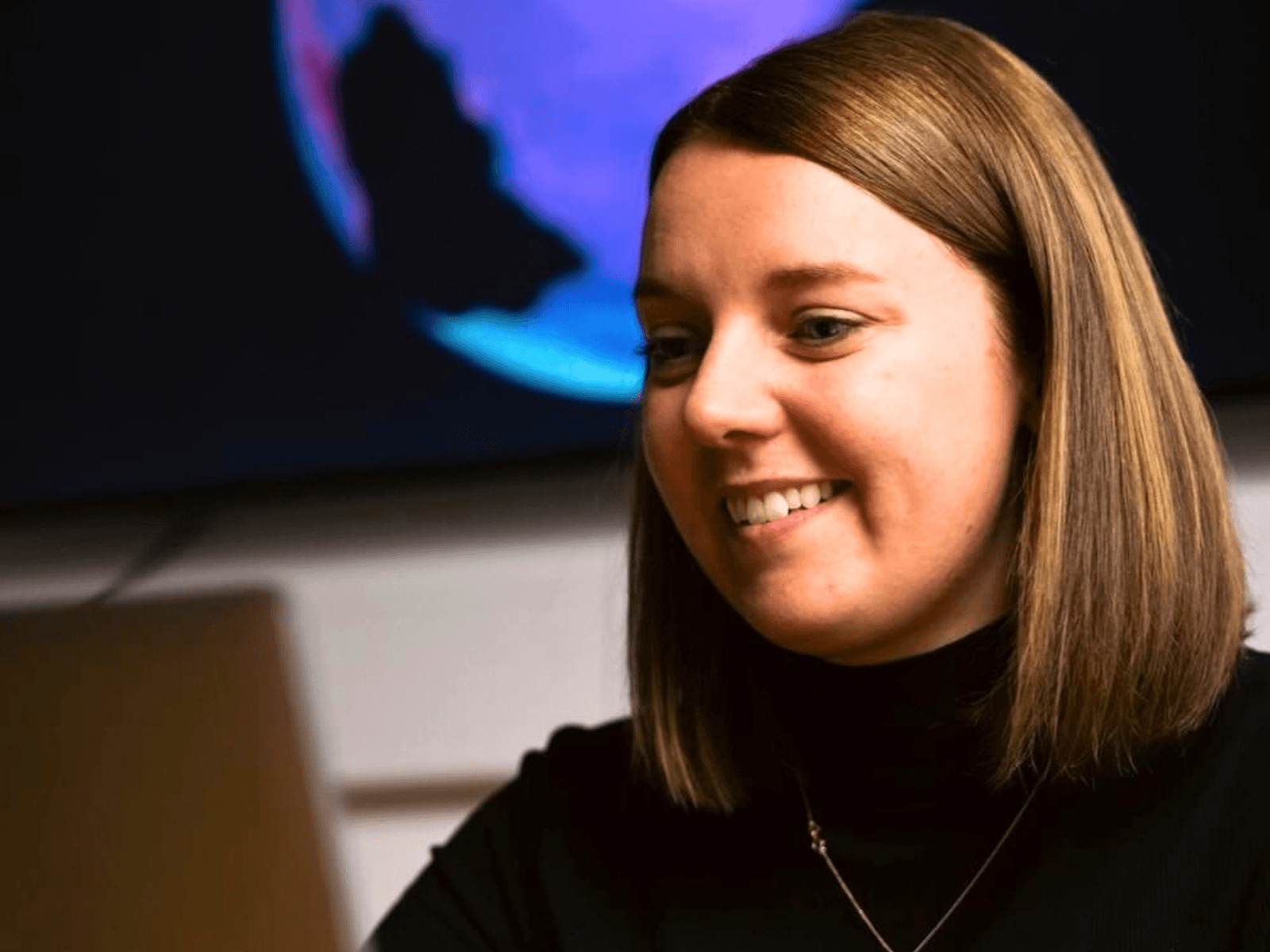
Ocean Biogeochemical Data and Model Analyst Dr. Chelsey Baker uses ocean and Earth system models — computer-based representations of how different parts of the Earth system interact — to explore questions around marine carbon dioxide removal (mCDR) that can’t be answered through observation alone. Her work looks at questions ranging from the potential impacts of large-scale deployment to how carbon moves through the ocean over long timescales.
But communicating what models can and can’t tell us comes with its own challenges. Through the mCDR Communication Leaders program, Chelsey has been exploring how to make complex modeling more accessible, communicate uncertainty, and better understand what different audiences need from the science.
We spoke with Chelsey about the value of modeling, building communication skills, and what she’s learned from working alongside people with different perspectives and experiences across the mCDR community.
Can you tell us a little bit about your work and the role modeling plays in mCDR research?
Modeling allows us to explore different facets of a problem that we can’t always reach through observations alone — either because we can’t observe them directly, or because there are good reasons to model first to understand potential impacts and effectiveness before moving into the real world.
We can’t observe the future, for example. We also can’t always observe over the time and spatial scales we need to. If we’re thinking about what might happen if an mCDR approach were deployed at scale, we can use models to help us understand how different ocean properties, such as carbon and oxygen, may change over long timescales.
We can also test different scenarios. We can ask: If we implemented this mCDR approach here, what happens to the oxygen concentration? What happens to pH? What happens to other parts of the Earth system?
That’s where modeling brings real value.
What challenges come with communicating about models and projections, particularly when it comes to uncertainty? How do you address those challenges?
Models are a very broad set of tools. Just as there’s a huge range of ways to collect observations, there’s a huge diversity of modeling approaches.
You don’t necessarily need to get into all the technical details when you’re communicating about a model, but you want to give people confidence that you’re using a sensible tool for the question you’re asking. So, it’s important to explain what you’re modeling, what is represented, what isn’t included, and what those limitations might mean.
I think uncertainty is also difficult because when people hear the word “uncertainty,” they sometimes assume it means you just don’t know the answer. But uncertainty doesn’t mean we know nothing. It is a scale. There are different types and degrees of uncertainty.
One analogy I like is weather forecasting as it is a model output that most people interact with and use to make decisions on a daily basis. A forecast might not be able to tell you exactly whether it’s going to rain in your garden at 2:05pm. But it can tell you a window of when it might rain and how heavy the rain is likely to be. You use that information to decide whether you’re going to take an umbrella outside or have a barbecue.
So, we can understand and quantify uncertainty and still use that information to make informed decisions. The important thing is being clear about what the uncertainties are and how we can appropriately use the information that modeling provides.
What have you learned about making complex modeling work accessible to different audiences?
One of the biggest things I’ve taken away from the mCDR Communication Leaders program is that it’s really important to understand your audience — what they care about, what they already know, and what they need from the conversation.
What aspects of your research do decision-makers care about? What aspects do communities care about? Those aren’t necessarily always going to be the same. Understanding people’s motivations for engaging with a topic can help you develop much more effective, tailored communication.
I’ve also learned that we shouldn’t be afraid to share some level of detail. I’ve seen (and I’ve done this myself) examples where we oversimplify so much and go so high-level that people don’t actually understand what we’re talking about. It’s so broad that it becomes difficult to understand what’s happening or what’s important.
I think good scientific communication is about making the research accessible and understandable without making it simplistic. And that’s surprisingly difficult to do with technical information.
Talking to people who aren’t that familiar with models has been incredibly helpful. I’ve been working with others in the cohort on an infographic to explain mCDR modeling in a more accessible way, because we couldn’t find anything that really did that. One of the cohort members said, “I care about the start-to-end process. Why not map out what model you would use at each stage of an alkalinity deployment to answer different questions?” And we thought, “Yes! That makes sense.”
That experience showed me how useful it can be to test your messages with people who aren’t familiar with your work. They can help you see the information in a completely different way.
How has the program changed how you think about your role in the broader mCDR conversation?
I’m in this space because I think there are still a lot of unanswered questions. We need experts with the background knowledge to ask those questions and really interrogate the answers independently.
Someone in one of the COMPASS sessions described themselves as the “skeptical scientist” about mCDR, and that really resonated with me. At first, I was hesitant to describe myself that way. But actually, that’s what I am, and I think it’s okay to share that.
mCDR is a contentious topic, and sometimes people assume that if you’re working on it, you’re automatically in favor of it proceeding. That’s not necessarily true. Being honest about that is important, and I think it can build trust.
What has the program been like as an opportunity to connect with people from different backgrounds and experiences?
It’s been incredibly valuable to have people from across the mCDR community in the cohort with different roles, expertise, and geographies.
In the UK, there hasn’t been much activity in terms of active deployments and so there hasn’t been much opportunity for me to engage with local communities around mCDR. Hearing about other people’s experiences has therefore been really valuable.
One conversation I had really brought home how important local context can be. I was talking with a US cohort member about topics that are contentious in different places, and they brought up offshore wind as an example of a really contentious issue in the US. That struck me because, in the UK, the contentious issue is more often onshore wind.
It was a useful reminder that you have to understand your audience and the wider context they’re coming from. If I went to the US to do mCDR engagement and decided to use an analogy involving offshore wind, that might be a bad idea!
Without that kind of conversation, you don’t necessarily know what might resonate with an audience. I think that’s particularly important for mCDR, where understanding local context is critical.
What advice would you give researchers who want their work to be more accessible?
A lot of communication is really about preparation.
Really think about the key question you’re trying to answer and the key messages you want to communicate. Think about the questions you’re likely to get. Develop useful analogies ahead of time. Make notes that you can come back to. Trying to come up with a good analogy on the spot doesn’t always go very well!
And once you’ve developed something for one audience or situation, you can build from it rather than starting from scratch every time.
You don’t need to have the perfect message from the start. It can be something you develop and improve through practice and conversation.